New market entries being granted on ‘spurious’ grounds says Day Lewis director
Arthur Walsh,
11 Oct 2026 2 Min
2 Min

Arthur Walsh,
11 Oct 20262 Min
Arthur Walsh,
11 Oct 20262 Min


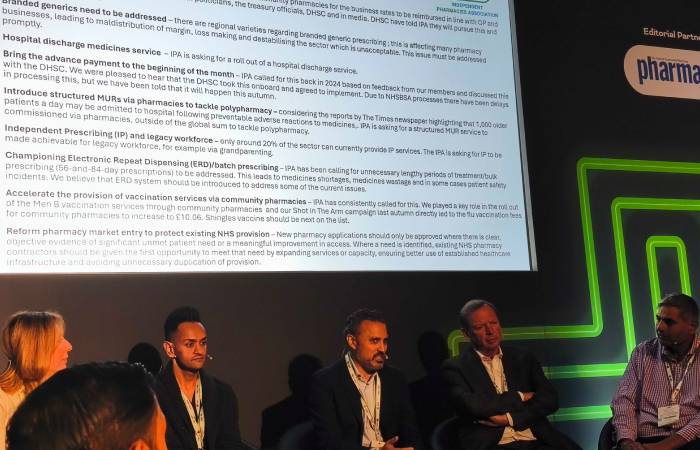
There is a “big issue” around how new pharmacy authorisations are being granted by local NHS decision-makers, Day Lewis director Jay Patel said today (October 11) at the Pharmacy Show in Birmingham.
Speaking on a panel of Independent Pharmacies Association contractor members, Mr Patel claimed “spurious contracts” are being granted that offer “marginal improvements” to accessibility of care, adding: “Somebody can say they're going to open for in the evening, one evening a week, and suddenly there's extra provision for the seven-day week.”
He said an identified need for greater pharmaceutical provision “should be a real need, and it should be determined against a real, solid criteria for a need – not just a want,” adding that the rules should “allow existing contractors to be able to actually meet that need”.
Reform to market entry rules features among the IPA’s proposed “quick wins” for improving the contractual framework, with the trade body arguing that where a need for services has been identified locally, “existing NHS pharmacy contractors should be given the first opportunity to meet that need by expanding services for capacity”.
This would help avoid “unnecessary duplication of provision,” claimed the trade body.
The panel discussion also included a debate around whether medicines margin or the single activity fee (SAF) would be more appropriate to place front and centre of funding negotiations; the IPA’s position is that while there is a “trade-off” between the two they should “ideally both be increased as they are both currently too low”.
Kent contractor Amish Patel made what he called the “controversial” suggestion that margin should be scrapped altogether as it would “fix a lot of problems”.
Mr Patel took an opposing line, citing the example of PPE procurement during the Covid-19 pandemic as proof that there is “no way that the Government can do this and do it effectively: cost-effectively, safely and efficiently”.
He added that margin “gives us the inventive to treat those products like they’re our own” and that removing this incentive would be harmful to both the public purse and, ultimately, patient outcomes.